Unified Add Lessons
-
Getting extra lessons at Preply was fragmented experience across multiple entry points, leading to confusion, incorrect purchases, and cancellations.
I led the end-to-end redesign of this experience, unifying two separate systems into a single flow that aligns user intent while preserving business goals around upgrades and monetization.
-
This project is currently in development.
Success metrics to track: drop-off rate at the choice step, cancelation rate, and overall top up and upgrade conversion from within the unified flow.
-
Established a scalable interaction system that reduces ambiguity, increases predictability, and creates a foundation for future growth and experimentation.
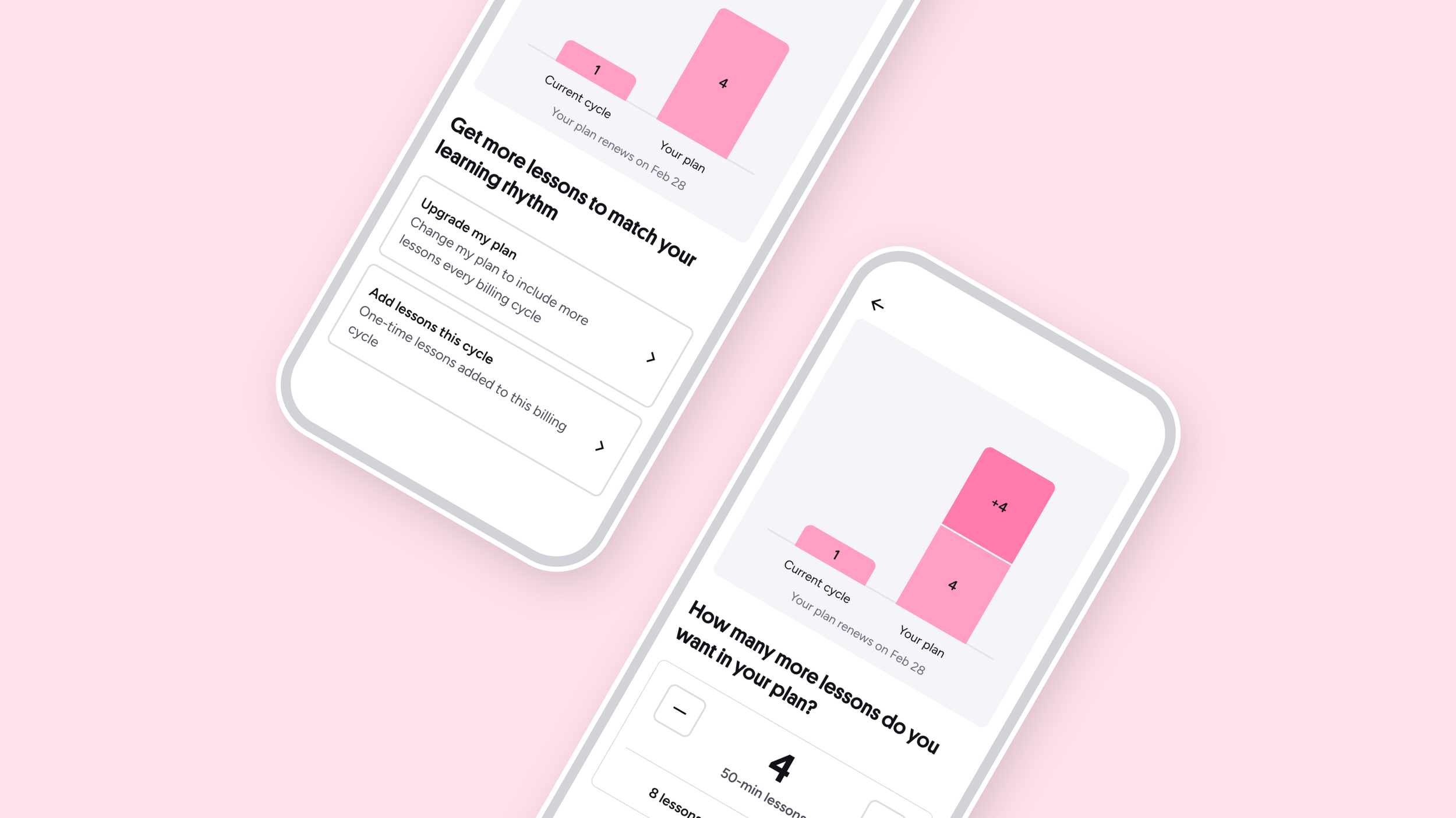
— The ProblemLearners were given multiple ways to add extra lessons to continue with their learning journey. These entry points led to different flows, different mental models, and inconsistent expectations around pricing, billing, and lesson availability. The system required users to understand product logic before taking action.
As a result, learners hesitated, dropped off, or felt unsure about whether they were making the right choice for their learning needs.
Key Challenges
-
Users don’t think in “Top-ups” vs “Upgrades” → they think in “I need more lessons”
— Conflicting mental models
-
Upgrades drive long-term revenue, while one-off lessons offer the flexibility users prefer.
— Business VS User tension
-
This flow directly drives monetization, making changes both high-risk and high-impact.
— High impact surface
. Design Process
. Design Process
Behavioral analysis
Two separate flows existed for adding lessons: upgrading a subscription or purchasing lessons one-off. While structurally correct, this distinction did not match how users approached the problem.
Most learners weren’t thinking in terms of “plans” or “top-ups.” They simply wanted more lessons.
Instead of optimizing the existing flows, the focus shifted to redefining the experience around a single question:
How might we allow users to get more lessons without requiring them to understand how the system works underneath?
Rather than improving clarity within each flow, the goal became to remove the need for users to choose between them altogether.
Reframing the problem
Concept explorations
Several concepts were explored to address this challenge, each tackling the problem from a different angle.
Each concept represented a different balance between simplicity, flexibility, and business impact.
The product was exposing its internal billing architecture as a user decision. But users don't have a billing model in their head, they have a learning goal.
The design solution was to build a presentation layer that absorbs the system complexity and only surfaces the user's actual question: how many lessons, and how often.
System insight
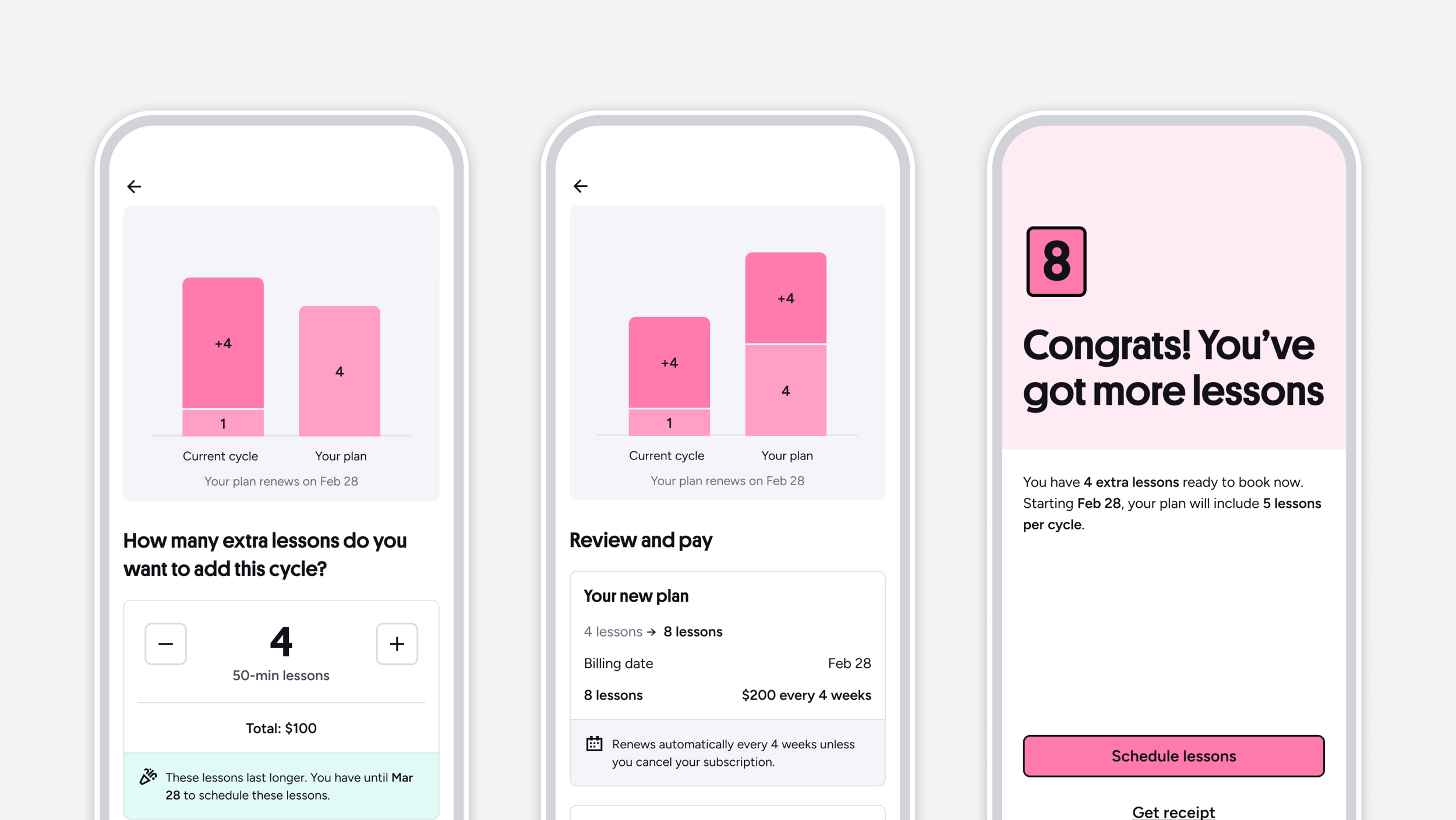
The focus of the validation was not only on whether users could complete the flow, but whether they understood what was happening at each step. Testing revealed that users were able to navigate the experience with confidence, particularly when supported by visual feedback that reflected their decisions in real time.
User validation
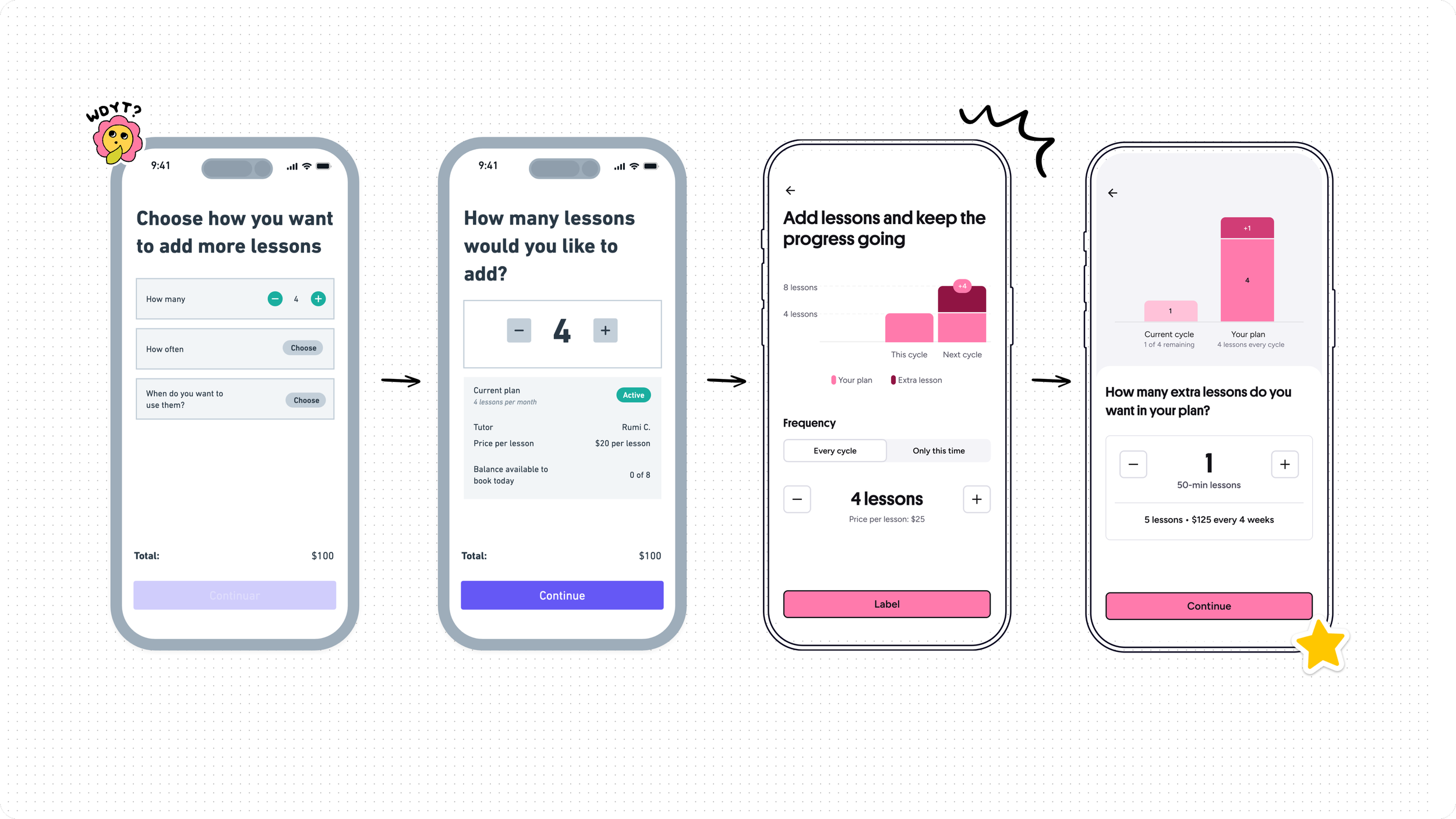
The final solution is not a simplified flow, but a system that adapts to user intent.
It replaces fragmented decision paths with a single, predictable model, balancing flexibility for users with structured opportunities for monetization.
Impact
On Business
This project is currently in development.
Hypothesis: By removing the cognitive cost of choosing between top-up vs upgrade, we will reduce post-purchase cancellations and improve upgrade conversion.
Success metrics tracked: drop-off rate at the choice step, cancelation rate, and overall top up and upgrade conversion from within the unified flow. Early internal validation confirmed the system handles edge cases the previous design had no solution for.
Design
Shifted the experience from a internal-driven structure to a user-driven model, aligning product logic with user intent.
Established a scalable interaction system that reduces ambiguity, increases predictability, and creates a foundation for future growth and experimentation.