AI Message
Experimentation
-
First-message conversion was a known missed opportunity for Preply, since messaging a tutor before booking a trial played an important role in helping learners feel confident about their choice.
I led the design of an AI-assisted first-message experience that helps learners start conversations with tutors more confidently, while introducing AI in a way that feels supportive, natural, and fully under user control.
-
Drove a +4.7% uplift in lead-to-trial conversion during the experimentation phase.
The concept targeted a critical but underdeveloped point in the funnel, where learner confidence directly impacts trial booking. By lowering the barrier to starting a conversation, it increased tutor engagement, improved message quality, and drove stronger conversion into trial lessons.
-
This project produced three principles now applicable across Preply's AI roadmap: reuse context users already gave you rather than asking again; treat blank states as underlap opportunities, not neutral starting points; and introduce AI at the moment of highest anxiety, where small reductions in effort have outsized impact on conversion.
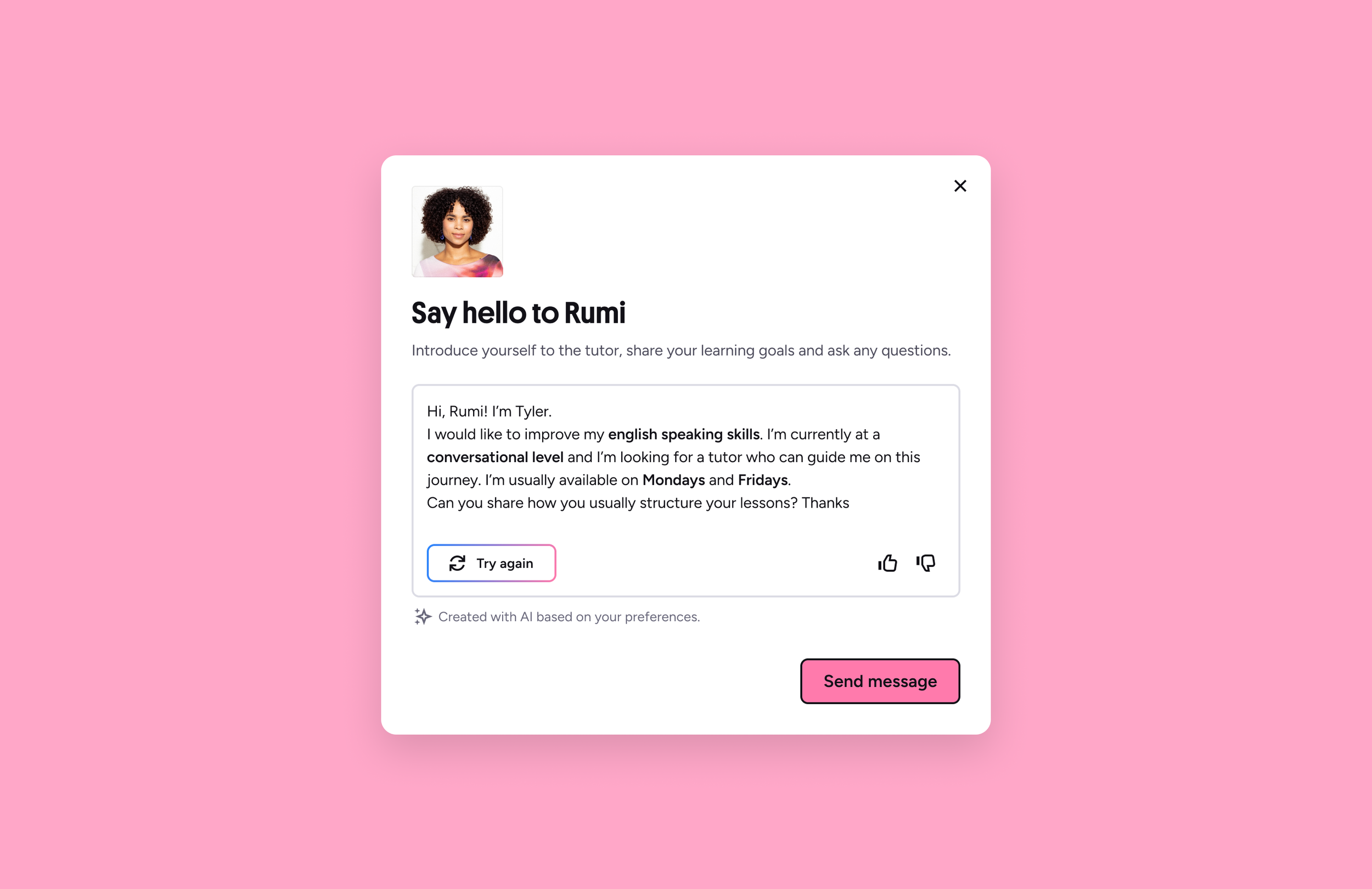
— The ProblemMany learners contact tutors before booking a trial lesson as a way to assess fit, introduce themselves, or clarify expectations. These conversations are strongly connected to trial conversion, yet the experience of writing that first message was left entirely blank.
Learners often did not know what to say, repeated information they had already shared earlier in the journey, or sent short, low-quality messages that did not reflect their goals.
Key Challenges
-
Learners needed help expressing themselves, but without feeling that the system was taking over.
— Confidence X Effort
-
Introducing AI at an early point in the funnel required care, especially in a personal interaction between learner and tutor.
— Trust in AI
-
The experience had to feel helpful without making the message feel generic or inauthentic.
— Control
-
The system already knew relevant information about the learner, but the messaging experience was not using it.
— Continuity across the funnel
. Design Process
. Design Process
The first step was understanding what role messaging actually played in the journey. Learners were using messaging to reduce uncertainty, assess compatibility, and feel more prepared before committing to a tutor.
Behavior and opportunity
Several levels of AI involvement were explored.
One direction treated AI as optional assistance, triggered through a CTA when users wanted help writing. Another introduced AI more proactively, generating a first draft automatically when users entered the messaging step.
These concepts reflected different assumptions about agency, trust, and user effort.
Concepts
A/B insight: when AI assistance required an extra tap, engagement was near zero. When the draft appeared automatically, users engaged and converted at a meaningfully higher rate.
Validation and learning
The key design decision was where to put AI on the spectrum between invisible and visible. Too hidden, and users never engaged with it. Too prominent, and it felt like the product was putting words in their mouth before they'd even met their tutor.
The sweet spot: a full draft, auto-generated from context already collected in the funnel, editable by the user at any time. AI does the heavy lifting of the blank page. The learner owns the final message.
Key Insight
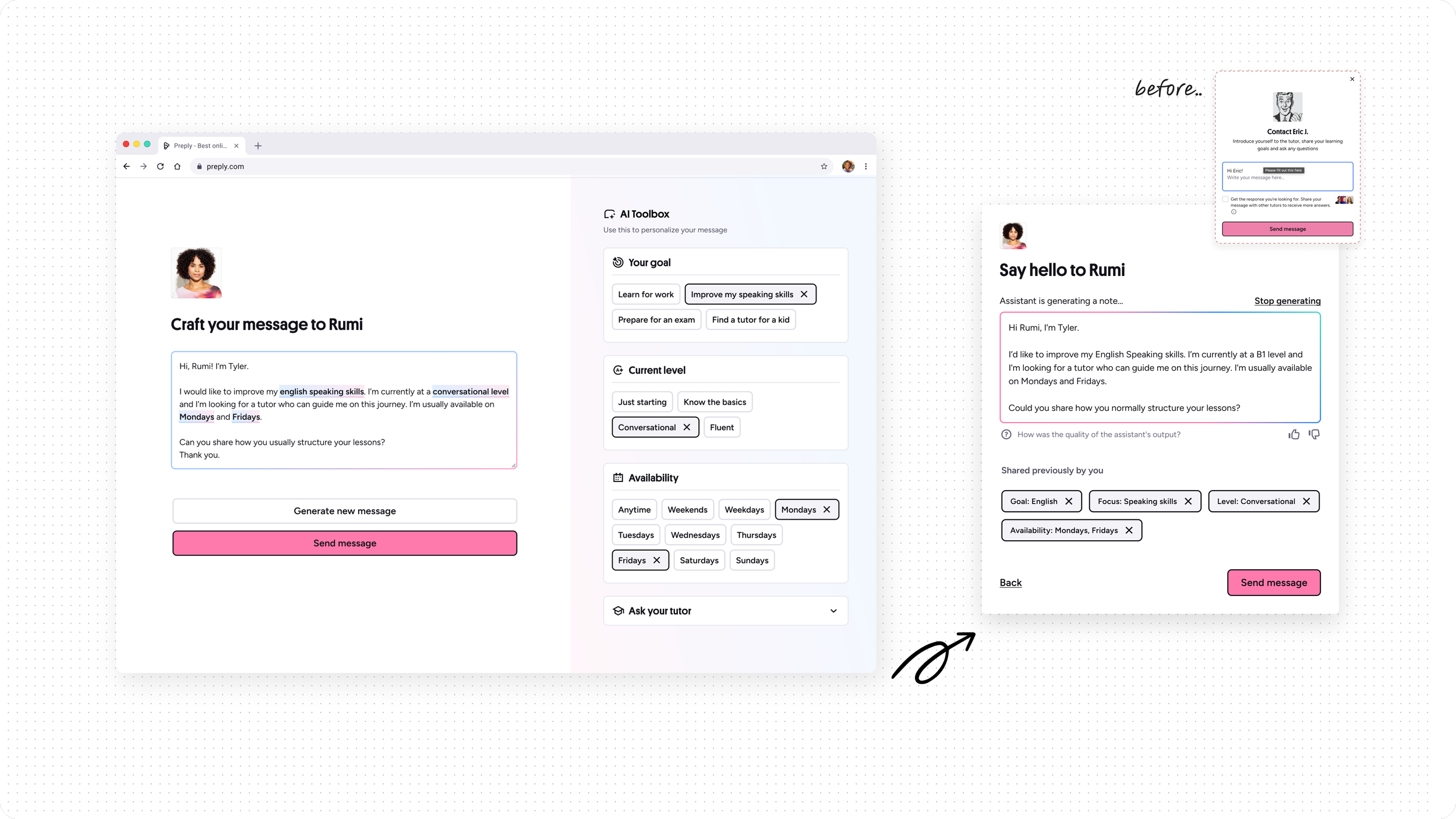
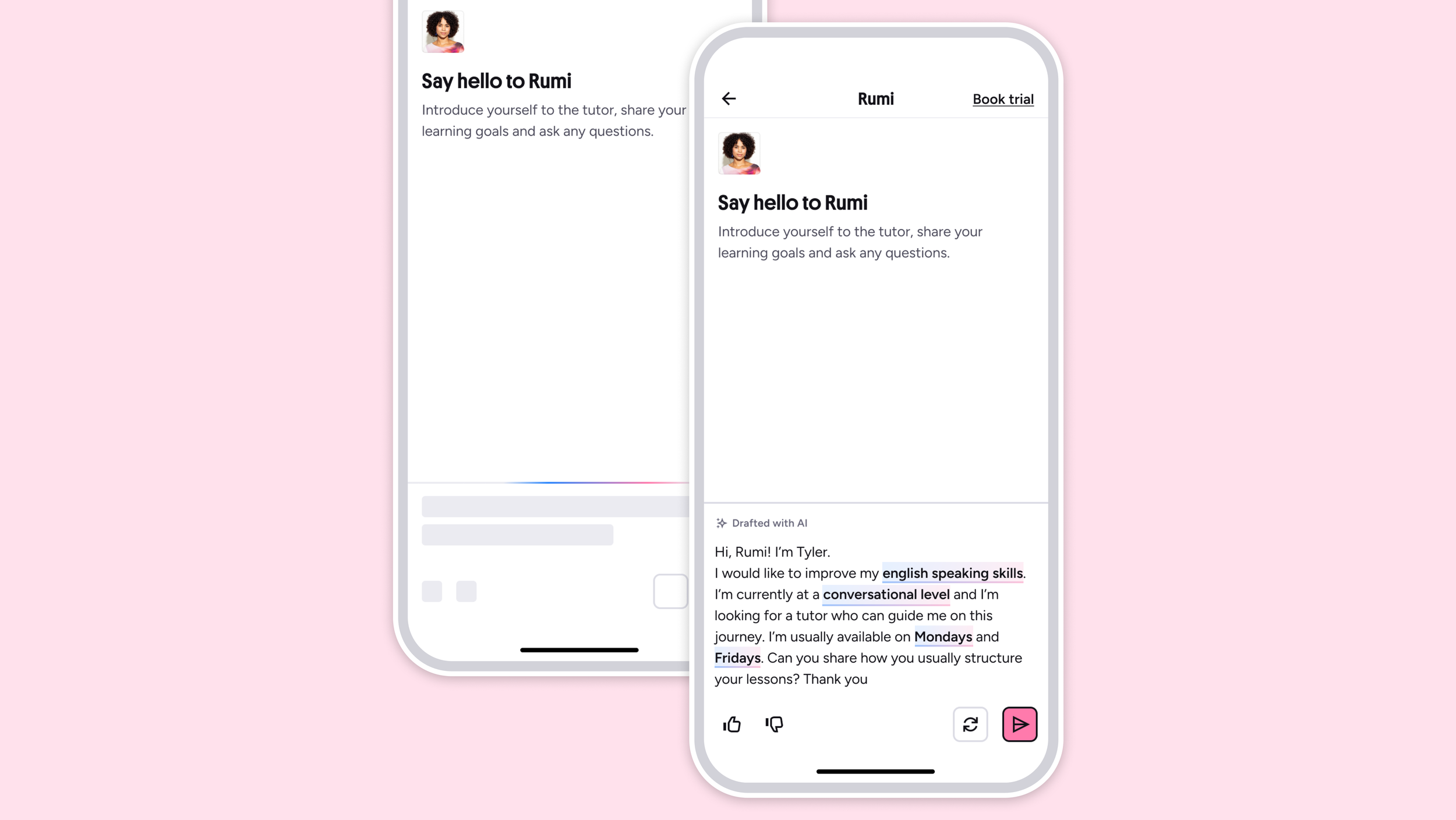
Instead of asking users whether they wanted help, the system automatically generated a first draft based on information already collected earlier in the journey, such as goals, preferences, and availability.
— AI as a quiet collaboratorThis removed repetition, reduced cognitive load, and made the experience feel more connected to the rest of the funnel.
At the same time, control remained fully with the learner. Users could edit the message, regenerate it, or delete it and start from scratch. This preserved authorship while allowing AI to do what it does best: eliminate the friction of the blank page.
Impact
On Business
Drove a +4.7% uplift in lead-to-trial conversion during the experimentation phase.
The concept targeted a critical but underdeveloped point in the funnel, where learner confidence directly impacts trial booking. By lowering the barrier to starting a conversation, it increased tutor engagement, improved message quality, and drove stronger conversion into trial lessons.
It also established a foundation for introducing AI in a way that supports core user behavior earlier in the funnel.
Design
This project produced three principles now applicable across Preply's AI roadmap: reuse context users already gave you rather than asking again; treat blank states as underlap opportunities, not neutral starting points; and introduce AI at the moment of highest anxiety, where small reductions in effort have outsized impact on conversion.